



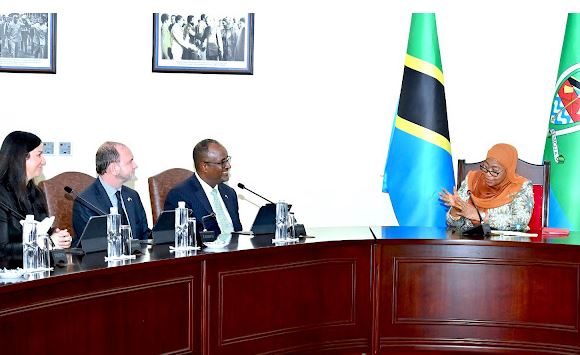
Tanzania has continued to attract major development institutions in the world due to the pace of economic reforms, infrastructure investments and efforts to improve the lives of citizens through the education, health and youth employment sectors.
This was stated by World Bank leaders during their talks with the President of the United Republic of Tanzania, Dr. Samia Suluhu Hassan held at the State House, Dar es Salaam.
In the World Bank’s assessment, Tanzania currently continues to be among the countries that offer great hope for economic growth in Africa due to its political stability, resource management and its long-term development orientation.
WORLD BANK SEES TANZANIA TOWARDS A STRONGER ECONOMY
Former World Bank Resident Director in Tanzania, Mr. Nathan Belete, said Tanzania has made great strides in various important sectors that directly affect the lives of citizens.
He cited the achievements in the health, education, energy, water and sanitation sectors as evidence of how the Government has planned to enhance the well-being of its citizens.
According to Mr. Belete, Tanzania has also demonstrated a strong ability to manage the implementation of development projects effectively, which has continued to build its respect in international development institutions.
These statements show that the ongoing reforms in the country are not just short-term, but are part of the journey towards becoming the most competitive economy in the East African region.
VISION 2050 RAISES GREAT EXPECTATIONS
The World Bank has also expressed its interest in the preparations for the implementation of the National Development Vision 2050, while explaining that Tanzania is in a good position to harness the power of youth and the private sector to accelerate economic growth.
In a technical analysis, the institution sees that Tanzania can become an important hub for trade, transport and investment due to its strategic position in the African region.
Mr. Belete said Tanzania has a favorable environment to attract private sector investment in key areas including the modern SGR railway, ports, energy and other major development infrastructure.
This is a sign that the world continues to believe in Tanzania’s ability to manage large projects that are productive for the national economy.
YOUTH WILL BE NAMED AS THE FORCE OF THE FUTURE ECONOMY
In the talks, the World Bank has placed great emphasis on investing in youth through education, job skills and employment.
Belete said the ongoing technical and vocational education reforms in the country will help youth acquire the skills needed in a modern economy.
The new World Bank Country Director in Tanzania, Mr. Firas Raad, said economic growth must go hand in hand with job creation to reduce poverty and improve the lives of citizens.
He said the World Bank will continue to collaborate with the Government in strengthening education, health and social security as these areas are the basis for building human resources capable of competing in the global economy of the future.
PRIVATE SECTOR IS GIVEN A GREATER ROLE
In another move, the World Bank has highlighted the importance of increasing private sector participation in Tanzania’s development.
Mr. Firas Raad said that due to the increase in development needs, there is a need to attract more private sector capital to support the implementation of major development projects.
He said the World Bank will continue to help Tanzania improve the business and investment environment to increase economic competitiveness and bring greater results to the people.
TANZANIA CONTINUES TO BUILDING INTERNATIONAL TRUST
Overall, the World Bank assessment shows that Tanzania has continued to be an example of a country that is building its economy on the basis of stability, infrastructure investment, people’s development and private sector participation.
At a time when many countries in the world are facing economic challenges, Tanzania continues to be seen as one of the countries with great prospects for long-term development in Africa.