



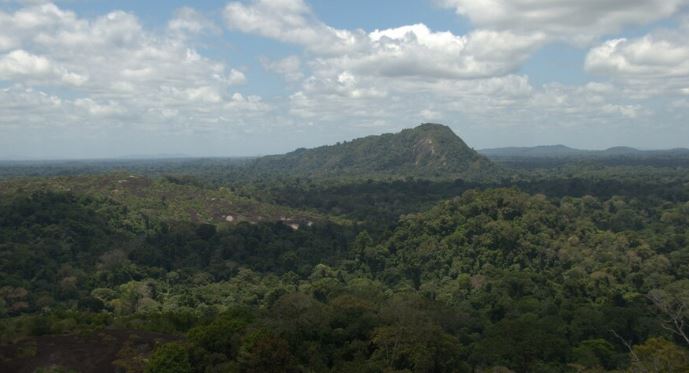
Out of every hundred hectares of land in Suriname, ninety-four are covered by forest. The world’s most forested country takes us from a European fairy tale to a South American rainforest that protects rivers, provides a home for thousands of species and helps regulate the climate.
Little Red Riding Hood was asked to take some food to her grandmother. Nobody ever told us what country her grandmother lived in. Charles Perrault published his version of the tale in Paris in 1697. The Brothers Grimm published theirs in Berlin in 1812.
Both left the forest unnamed. Imagine, for a moment, that it was in Suriname. The girl could have used a map. So could the wolf.
The real map is almost as surprising as the fairy tale. According to the FAO’s 2025 assessment, forests cover 94% of Suriname’s land area, the highest share of any sovereign country. Across the planet, forests cover 32% of the land. In this corner of South America, forest stretches across almost the entire map.
Water begins among the trees
Follow the Coppename River upstream. There, the Central Suriname Nature Reserve, a UNESCO World Heritage Site, protects around 1.6 million hectares of primary tropical forest and the headwaters of several rivers. Jaguars, tapirs and giant otters live there. Around 400 bird species have also been recorded, among them the harpy eagle.
When rain falls on the forest, some of the water seeps into the soil. The vegetation helps slow surface runoff and reduce erosion. The effects are felt downstream.
The size of the forest also gives wildlife room to move. A jaguar needs space to roam. A giant otter relies on rivers where it can catch fish. Protecting the forest and protecting its rivers are, in large part, the same job.
A standing forest also protects the climate
As trees grow, they take in carbon dioxide from the air and incorporate it into their tissues. Some of that carbon is stored in trunks, roots and soils.
When a forest is cleared and the vegetation is burned or decomposes, some of the carbon returns to the atmosphere as CO₂. Keeping those trees standing helps prevent greenhouse gas emissions. That is one reason what happens in Suriname’s forests matters wherever we live.
To the west, Guyana broadens the story. According to the same FAO assessment, forests cover 93% of its land area. Together, the two countries account for about 33 million hectares of forest in northern South America. In Guyana, a walkway among the treetops at Iwokrama offers a view of some of that expanse. Both countries share the Guiana Shield, a region that still holds some of the Americas’ great stretches of tropical forest.
Thank you for keeping the forest standing
Caring for that forest is the work of real people. In southern Suriname, Indigenous Trio and Wayana communities help protect the lands and rivers they depend on. Their efforts matter in a country where the expansion of gold mining continues to cause forest loss. The benefits of keeping the forest standing reach across borders. Much of the work falls to those who live there.
Little Red Riding Hood can lose her way each time someone opens the book. Suriname’s forest is still standing and doing work that humanity depends on every day. Its soils and trees store carbon. Its headwaters are protected. Its vastness gives thousands of species somewhere to live.
Thank you, Suriname, for caring for one of humanity’s great green lungs.
Rubén Darío Basay Roberts
Writer, media professional and public policy student
basayroberts.cl
Sources
- Bibliothèque nationale de France, Perrault’s 1697 edition
- French text of Little Red Riding Hood from the 1697 edition
- University of Pittsburgh, versions of Little Red Riding Hood, including the Grimms’ 1812 version
- FAO, Global Forest Resources Assessment 2025, Table 4
- FAO, 2025 Global Forest Resources Assessment overview
- UNESCO, Central Suriname Nature Reserve
- World Bank, Suriname Country Environmental Analysis
- Conservation International, carbon storage in Suriname
- Iwokrama International Centre, sustainable tourism
- Conservation International Suriname, community-led conservation by the Trio and Wayana
- MAAP, gold-mining-related deforestation in Suriname
- Brothers Grimm, German text of Rothkäppchen from the 1812 edition
- FAO, Global Forest Resources Assessment 2025 data platform
- UNESCO, decision to inscribe the Central Suriname Nature Reserve
- Suriname’s third nationally determined contribution under the Paris Agreement
- Guyana, forest reference level submitted to the UN Framework Convention on Climate Change