



Today, November 26, 2026, marks 104 years since British archaeologist Howard Carter first looked inside Tutankhamun’s tomb in Egypt. The discovery transformed archaeology and helped us understand how an extraordinary civilisation interpreted life, death and eternity.
While empires disappeared, religions emerged, cities rose and humanity experienced great revolutions, a young pharaoh remained hidden beneath Egyptian soil.
For approximately 3,244 years, darkness protected his belongings and the traces of a life that had not reached twenty years. On November 26, 1922, candlelight broke that ancient silence.
Why did we want to find him?
Tutankhamun ascended the throne at approximately nine years of age and died around 1323 BCE.
His brief reign was not among Egypt’s most glorious, yet archaeological discoveries suggested that his burial place might still lie in the Valley of the Kings.
Howard Carter was convinced. Supported financially by Lord Carnarvon, he persevered for years, even when other researchers considered the prospects of finding new royal tombs nearly exhausted.
On November 4, 1922, his team discovered the first steps leading to the burial site. Twenty-two days later, Carter looked inside.
This was more than the discovery of treasure. It was the recovery of part of humanity’s memory.
What was inside the tomb?
Around 5,400 objects were recorded across its four chambers. Their study, conservation and removal took approximately a decade.
There were beds, chairs, chariots, jewellery, sandals, clothing, food, board games, musical instruments and representations of deities.
The mummified remains of two girls, probably the pharaoh’s daughters who did not survive pregnancy, were also found.
His body rested inside three nested coffins within a quartzite sarcophagus. The innermost coffin was made of solid gold and weighed approximately 110 kilograms.
His famous funerary mask, weighing about eleven kilograms, is one of the most remarkable achievements of ancient goldsmithing.
Yet perhaps the most moving objects were not the most valuable financially. His sandals, games and personal possessions reminded us that before becoming a pharaoh, he had been a child.
How did he survive the passage of centuries?
Ancient Egyptians developed complex mummification techniques intended to preserve the body for the afterlife.
They used natron, a natural mixture of salts, to dehydrate tissues, alongside resinous substances and numerous layers of linen.
The dry environment, darkness and materials that eventually concealed the entrance helped preserve the burial site.
However, the mummy did not remain intact. Embalming substances and the procedures used to remove it from its coffin caused considerable damage. There was also evidence of ancient intrusions by robbers.
Nevertheless, the assemblage survived in exceptionally valuable condition for scientific research.
What we learned from his solitude
Tutankhamun was buried with thousands of objects because ancient Egyptians understood death as a transition to another existence.
Food represented sustenance; boats, transportation; amulets, protection. Everything seemed prepared for a journey without return.
The tomb taught us that more than three thousand years ago, human beings were already seeking answers to the uncertainties that accompany us today.
What happens when we die? Will we meet those we love again? Is there a way to overcome oblivion?. Our technology has changed enormously. Our fundamental existential questions, much less.
What did Tutankhamun leave us?
The discovery expanded our knowledge of ancient Egyptian medicine, food, textiles, metallurgy, craftsmanship, music, religion and social organisation.
Modern CT scans and genetic analyses have provided information about his health, although the precise circumstances of his death remain debated.
We must also recognise the contribution of the many Egyptian workers who participated in the excavations and whose work was overshadowed for decades by Carter’s fame.
The photographs, drawings, plans and records of the expedition constitute an extraordinary documentary heritage.
Tutankhamun ultimately contributed more to human knowledge after his death than during his brief reign.
Where does he rest today?
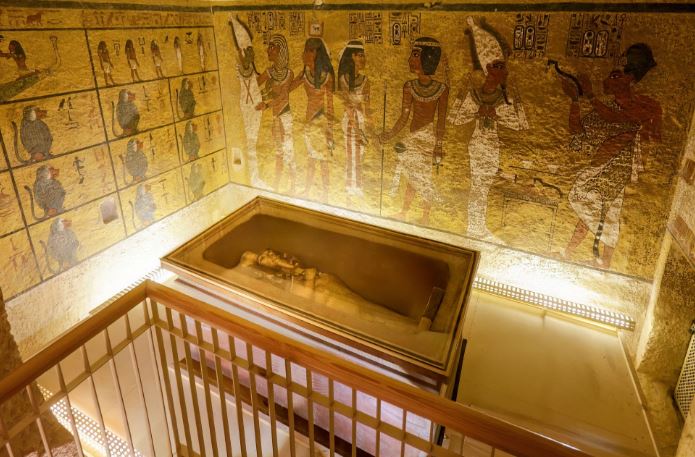
His mummy remains in his original tomb, KV62, in the Valley of the Kings near Luxor, protected by a specially designed display case.
The Grand Egyptian Museum, near the pyramids of Giza, is the major museum dedicated to bringing together and displaying his extraordinary funerary collection.
Preserving this heritage requires careful management of temperature, humidity, lighting and the effects of human presence.
We now have a responsibility to protect what time managed to preserve. Human beings in search of other human beings
Approximately 3,348 years have passed since Tutankhamun’s death, and there is still much left to discover.
Beneath the sands, in the depths of the oceans and among the remains of ancient civilisations lie human stories waiting to be told.
Perhaps the most extraordinary aspect of these discoveries is precisely this: human beings searching for other human beings, trying to understand their dreams, fears, knowledge and hopes.
Discovering our past helps us better understand our present. Knowledge makes us free.Tutankhamun barely had time to experience life, yet he ended up teaching us so much about it.
His story reminds us that life is here and now. It has a beginning and an end, but also an eternity that can manifest itself in what we leave to others.
Not all of us will leave pyramids, treasures or golden masks. But all of us have the opportunity to leave a mark on the lives of other human beings. Perhaps that is our most beautiful way of attaining eternity.
Rubén Darío Basay Roberts
Writer, communicator, speaker and student of public policy.