



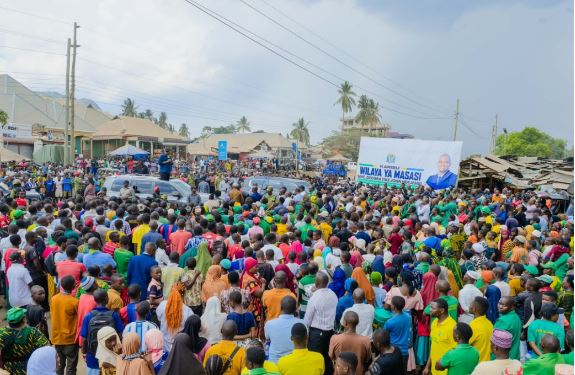
MASASI, MTWARA: The Vice President of the United Republic of Tanzania, Hon. Deogratius Ndejembi, has warned that the Government will not tolerate any extension officer, agricultural official, or trader found tampering with agricultural inputs or exploiting cashew farmers.
Speaking to the residents of Masasi in the Mtwara Region, the Vice President stated that the input subsidies provided by the administration of President Dr. Samia Suluhu Hassan are intended to boost production and increase farmers’ incomes; therefore, they will not be permitted to be used as a means for a few individuals to enrich themselves.
This warning follows a decline in cashew production—from 600,000 tonnes to 400,000 tonnes—amidst complaints from farmers that the agricultural inputs failed to yield the expected results.
The Vice President noted that when President Samia took office, production stood at 180,000 tonnes, subsequently rising to 600,000 tonnes after the Government introduced subsidies for sulfur-based agricultural inputs.
He has directed the Ministry of Agriculture to investigate complaints regarding the quality of these inputs—including allegations of tampering or a loss of potency due to prolonged storage—in order to identify the root cause of the decline in production. He urged farmers to continue working in their fields, assuring them that the Government will maintain subsidies and address challenges related to agricultural inputs, with the goal of restoring production to previous levels and eventually reaching one million tonnes.
Explaining the measures being taken, the Minister of Agriculture, Daniel Chongolo, stated that the supply of powdered sulphur was insufficient to meet demand this season. This necessitated the introduction of liquid sulphur, which did not perform well in some areas.
He noted that there was an initial stock of approximately 16,000 tonnes of powdered sulphur, followed by an additional 10,000 tonnes; however, the actual demand proved to be much higher.
Chongolo stated that a team of experts from TPHPA, TARI, and the Ministry of Agriculture has been deployed to conduct a thorough investigation to determine whether the issues stemmed from the agrochemicals themselves, the methods of application, or other factors.
He promised that, in preparation for the upcoming season, the Ministry aims to ensure that powdered sulphur reaches production areas by March of next year, allowing farmers to access it in a timely manner.
He emphasized that subsidized agricultural inputs are intended to economically empower farmers, and he issued a warning to those who might attempt to exploit these resources for personal gain at the expense of the public.
At the same meeting, the Member of Parliament for Masasi—who also serves as the Minister of Lands, Housing and Human Settlements Development—Dr. Leonard Akwilapo commended the Government’s investment in education, health, and infrastructure, while emphasizing the importance of increasing access to water services in the district.
Addressing the water issue, the Minister for Water, Hon. Jumaa Aweso, acknowledged a significant service gap; he noted that the demand in Masasi stands at 16 million liters, while only 6 million liters are currently being supplied—leaving a deficit of 10 million liters.
He stated that the Ministry of Water will provide emergency funds for immediate interventions, while a team of experts—working in collaboration with the Regional Administration, Masasi leadership, and the local community—develops both short-term solutions and a long-term, sustainable plan.
The Minister pledged to oversee the swift execution of these efforts, alongside preparations for a major project designed to meet the long-term needs of the people of Masasi.
Issued by
The Office of the Vice President
12 November 2026
Masasi – Mtwara.