



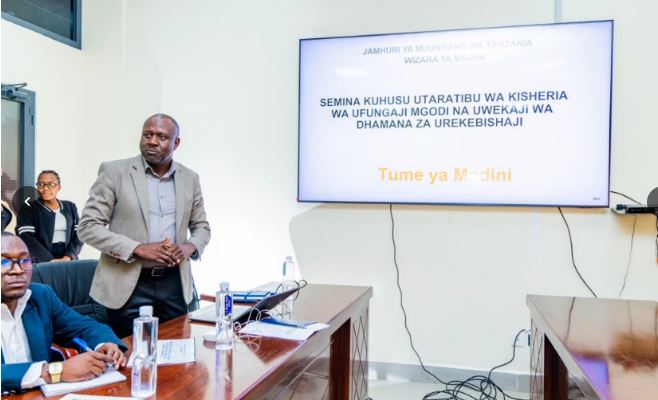
📍DODOMA: The Parliamentary Budget Committee has directed the Ministry of Minerals to strengthen the oversight and enforcement of laws regarding mine closure and environmental conservation. This includes conducting regular inspections to ensure that mining companies fulfill their obligations to restore mining sites to a safe condition once mining operations have ceased.
These directives were issued by the Committee Chairperson, Hon. Mashimba Ndaki—speaking on behalf of the Committee members—during a seminar on the legal framework for mine closure and the provision of rehabilitation bonds, held at the Mining Commission’s hall in Dodoma.
Hon. Ndaki emphasized the importance of ensuring that laws and regulations concerning mine closure are properly enforced to protect the environment and public safety, and to guarantee that areas used for mining activities are restored to an acceptable state.
He further stressed that the Ministry of Minerals, through the Mining Commission, must continue to bolster the supervision of mines and ensure that license holders comply with legal requirements regarding the preparation of Mine Closure Plans and the posting of Rehabilitation Bonds.
Hon. Ndaki commended the Ministry of Minerals, through the Mining Commission, for the progress made in increasing the mining sector’s contribution to the national economy; the sector currently contributes 10.3 percent to the central government budget.
The Minister of Minerals, Hon. Anthony Mavunde, stated that they have received the Committee’s directives and will act upon them. He thanked the Committee members for their valuable contributions toward improving the mining sector.
He noted that the government continues to strengthen the mining sector by implementing strategies aimed at increasing production, enhancing the participation of Tanzanians in mining activities, facilitating access to capital and technology, and improving the oversight of mines and environmental management.
Hon. Mavunde also mentioned that 67 tonnes of gold have been registered in the country annually—a development that underscores the sector’s importance in driving economic growth and increasing government revenue.
He stated that the government is collaborating with the Bank of Tanzania and various financial institutions to establish a Credit Guarantee Fund for miners. This initiative will assist them in securing loans to purchase equipment and technology, as well as to boost production.
Regarding the increase of government revenue, Hon. Mavunde stated that for the 2026/2027 financial year, the Mining Commission aims to collect 1.4 trillion shillings, having already collected 552 billion shillings during the period from July to October 2026.
He noted that the Government intends to increase collections to 800 billion shillings by December 2026, coinciding with the commencement of aerial mineral exploration surveys across various regions of the country, starting that same month.
Engineer Hamisi Kamando, the Mining Commission’s Director of Mine Inspection and Environment, speaking during the seminar, explained that the Commission has strengthened the oversight of mine closure processes. This involves ensuring that holders of large- and medium-scale mining licenses prepare and submit Mine Closure Plans for review and approval.
He stated that, in accordance with Regulation 206(1) of the 2010 Regulations on Safety, Health, and Environmental Protection, every holder of a large- or medium-scale mining license is required to prepare and submit to the Chief Inspector of Mines a plan detailing how the mining site will be rehabilitated and restored once mining operations have ceased. He added that upon receiving the plan, the Office of the Chief Inspector of Mines conducts an initial review before convening a meeting of the National Mine Closure Committee (NMCC) to deliberate and decide whether or not to approve it.
In accordance with Regulation 206(3), the National Mine Closure Committee comprises representatives from ministries responsible for minerals, the environment, water, and natural resources; regional and district authorities; the National Environment Management Council (NEMC); and other relevant institutions.
Engineer Kamando stated that a mine closure plan extends beyond merely closing the mining site; it encompasses the restoration of land and water sources, ensuring the safety of mine infrastructure, covering the payment of employees’ statutory entitlements, and implementing programs to enable communities surrounding the mines to engage in alternative economic activities.
He noted that to ensure these costs are covered, mine owners are required to establish Rehabilitation Guarantees, which may take the form of an escrow account, a capital guarantee, an insurance bond, or a bank guarantee. According to statistics presented at the seminar, there are 84 large- and medium-scale mines in the country; of these, 44 have submitted Mine Closure Plans, 36 have been reviewed by the National Mine Closure Committee, and 21 have been approved.
However, only two mines—North Mara and Bulyanhulu—have secured rehabilitation guarantees through the insurance company MUA, effective until January 16, 2026.
The Government continues to emphasize the importance of enforcing these regulations to ensure that mining operations are aligned with environmental conservation, public safety, and the sustainable development of communities surrounding mining areas.