



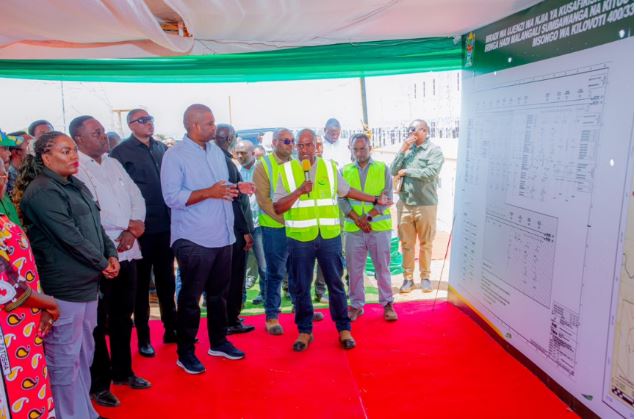
The Vice President of the United Republic of Tanzania, Hon. Deogratius Ndejembi, has stated that the Tanzania–Zambia Interconnector Project (TAZA) is a significant investment that will serve as a catalyst for economic development in the Southern Highlands regions. It will achieve this by ensuring a reliable power supply, boosting production, and unlocking new investment opportunities.
Hon. Ndejembi made these remarks on October 15, 2026, during an inspection visit to assess the progress of the TAZA project, including the infrastructure at the power receiving and step-down substations in Malangali (Rukwa Region) and Nkangamo (Songwe Region).
Speaking at the Malangali power receiving and step-down substation, Hon. Ndejembi noted that the Rukwa Region has faced challenges regarding the availability of sufficient electricity—a situation that has hindered production activities and the region’s economic growth. He explained that the Rukwa Region currently receives approximately 16 megawatts of electricity, while its demand stands at 30 megawatts. This shortfall impacts various economic activities—particularly the processing of agricultural produce—forcing some farmers to sell raw crops instead of processing them to add value and increase their income.
“Following directives from the President of the United Republic of Tanzania, Dr. Samia Suluhu Hassan, it was ordered that the Rukwa Region be connected to the National Grid to address the challenge of electricity supply. This is why the implementation of this project began in 2023,” stated Hon. Ndejembi.
He emphasized that a reliable power supply is a crucial foundation for development, as it will enable citizens to expand business activities, establish industries, add value to agricultural produce, and attract investors—steps that will stimulate job creation and improve the livelihoods of the people.
The TAZA project involves the construction of a 400-kilovolt (kV) high-voltage power transmission line, spanning approximately 618 kilometers from Iringa to Malangali in the Rukwa Region.
While visiting the Nkangamo Power Substation in the Songwe Region—where construction has reached 83 percent completion—Hon. Ndejembi stated that the project will help resolve long-standing challenges regarding electricity access and strengthen energy infrastructure to meet growing demand.
“This line spans 618 kilometers from Iringa to Rukwa and will eliminate persistent electricity-related challenges, while unlocking further opportunities for economic development,” said Hon. Ndejembi.
He noted that Tanzania’s geographical location positions it as a vital hub for electricity trade between East African and Southern African nations. Through the TAZA Project, Tanzania will enhance its capacity to engage in energy trade with neighboring countries—including Zambia—via the Southern African Power Pool (SAPP).
Hon. Ndejembi urged citizens to protect the electricity infrastructure, which is being constructed at a significant cost to the Government, explaining that these facilities are public assets intended to improve energy services, boost the economy, and foster sustainable development.
The implementation of the TAZA Project is part of the Government’s efforts to strengthen the National Grid, expand access to reliable electricity, and leverage energy as a catalyst for industrial, commercial, and agricultural development, as well as investment within the country.