



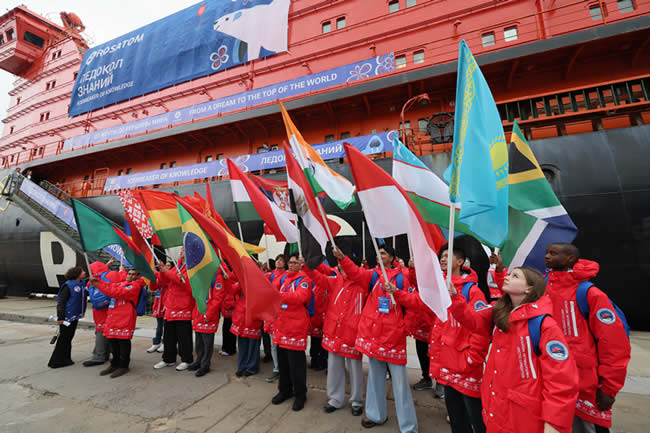
Almost 5,000 teenagers from 22 countries competed for a dream journey to the North Pole aboard Rosatom’s nuclear-powered icebreaker 50 Let Pobedy – and this year a young Tanzanian won her place and has already set off for the very top of the planet.
A solemn departure ceremony for the international Icebreaker of Knowledge expedition was held in Murmansk. Captain of the nuclear-powered icebreaker 50 Let Pobedy Ruslan Sasov issued the order to set sail, and the ship set off on its route from Murmansk to the North Pole, Franz Josef Land, and back to Murmansk.
The total duration of the expedition will be 10 days. During the voyage, participants will explore the nature of the Far North, observe the operation of a nuclear-powered icebreaker, and learn more about the role of nuclear technology in the development of Arctic shipping. The students will bring their countries’ flags to the North Pole, making the moment of reaching the 90° mark particularly symbolic. Beyond the journey itself, the voyage will give students from around the world a rare opportunity to see the Arctic with their own eyes and become part of an international community of young researchers united by an interest in science, technology and the future.
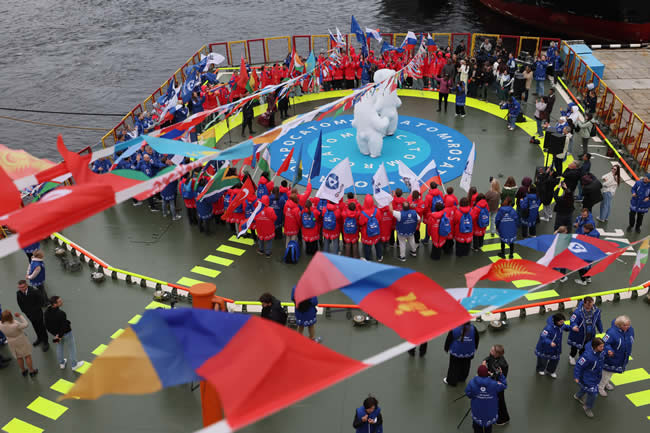
“The Arctic is a place of power, where the most ambitious ideas are born and brought to life. This is where bold and active people who are ready to build a better future come. The Icebreaker of Knowledge is taking exactly these kinds of children to the North Pole. And we are proud that our nuclear-powered icebreaker fleet – the only one of its kind in the world – provides them with this opportunity. On board the nuclear-powered ship 50 Let Pobedy, the students will learn about technologies they won’t see anywhere else. We want to harness the energy of the best young minds to advance science and protect the planet. This energy is the main driver of progress,” noted Rosatom Director General Alexey Likhachev.
The competition for a place on board lasted months and drew about 5,000 students from 22 countries, including Tanzania, Namibia, South Africa, Rwanda, Egypt, Armenia, Bangladesh, Belarus, Bolivia, Brazil, Hungary, Vietnam, India, Indonesia, Kazakhstan, China, Kyrgyzstan, Mongolia, Myanmar, Serbia, Turkey, and Uzbekistan. The selection process unfolded in three stages: a science quiz, a series of webinars with nuclear industry experts, and a final round in which ten finalists per country presented creative projects on the theme “How Nuclear Technologies Are Changing the World Today.”
“This still feels almost unreal to me. It is like something out of a movie: a nuclear icebreaker, the Arctic, snow and ice – and suddenly I am part of it all. Today I am representing Tanzania, and that makes this moment even more powerful. Very few people ever get the chance to stand at the very top of the planet. I want to absorb every second of this journey and show everyone that curiosity and courage can take you anywhere,” emphasised the Icebreaker of Knowledge 2026 participant Xyleen Mapunda from Tanzania.
Once aboard, that anticipation gives way to a packed educational programme that kicks off on the very first day. Participants can look forward to lectures, workshops, discussions, scientific experiments, career counselling, creative activities, as well as memorable symbolic events – from postcards sent from the northernmost post office to a “round-the-world journey” at the point where all meridians intersect.
Leading international experts will work alongside the expedition participants aboard the nuclear-powered icebreaker. Among them are Project Manager at the Laboratory of Genomic Technologies and Tissue Engineering of JSC NIITFA Egor Plakhotnyuk; Deputy Chief Engineer of the Beloyarsk NPP Andrey Smelov; General Director of CONSIST-OS (IT integrator for Rosatom’s Electric Power Division) Ilya Kholkin; Director of Communications at the Brazilian Association of Nuclear Energy Jairu Silva Bastos; physician, science communicator and expert of the Mwanachuo Family Foundation of Tanzania Dr Noel Rajabu Mabele; and Professor at the Department of Marine Biology, Cochin University of Science and Technology, India, Dr Bijoy Nandan.
Beyond the science curriculum, the voyage also has a creative dimension: popular performers and bloggers, as well as the well-known Russian science fiction writer Sergey Lukyanenko, will be special guests on the voyage. During the Arctic expedition, he will lead a creative workshop for the participants: the author will provide an intriguing opening for a science fiction story, and the students will propose their own versions of the ending. Following the expedition, the complete collaborative work will be officially published.
Rosatom pays special attention to supporting and developing educational, scientific, enlightenment and cultural initiatives, including establishing industrial partnership departments in Russian universities, scholarship programmes, and internships and apprenticeships for students with subsequent employment opportunities.
For Tanzania, the Icebreaker of Knowledge expedition represents the country’s debut in this international Arctic project and opens up new opportunities for cooperation in education and science. In parallel, Rosatom is developing the Mkuju River uranium mining project through Mantra Tanzania Ltd., a subsidiary of Uranium One Group (a part of Rosatom Group).
The project is creating jobs and training Tanzanian technical specialists, will include a dedicated Training and Competence Centre for operational personnel, and supports local communities through initiatives in healthcare, education, access to clean water, entrepreneurship and environmental protection. Together, these efforts help develop Tanzania’s human capital and contribute to the country’s long-term sustainable growth.
Fact Sheet:
The scientific and educational project Icebreaker of Knowledge is organised with the support of Rosatom. It is aimed at promoting natural science disciplines and technologies of the nuclear industry, finding and supporting talented and gifted children, developing their abilities and offering career guidance. The project brings together school students and students of secondary vocational education programmes aged 14–16 from around the world. The top performers join a scientific and educational expedition to the North Pole aboard the nuclear icebreaker 50 Let Pobedy.
Over the six seasons of the Icebreaker of Knowledge project, more than 400 talented schoolchildren from around the world have participated in Rosatom’s Arctic expeditions to the North Pole. The project offered them a unique opportunity to see an operational nuclear-powered icebreaker up close and learn about advanced scientific and technological developments in Russia’s nuclear industry.