



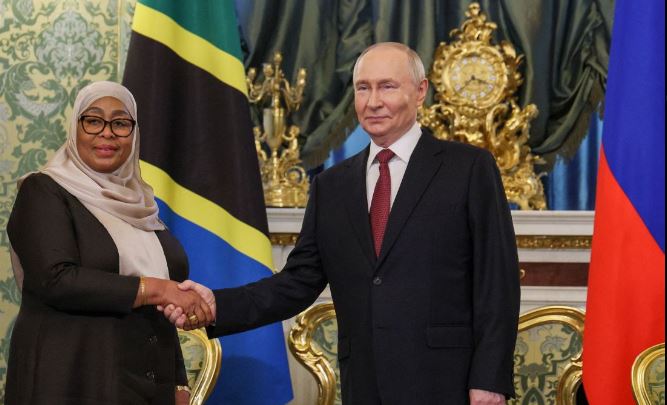
By Beda Msimbe, TBN, formerly in Russia
For years, energy discussions in Tanzania have been dominated by hydropower, natural gas, and now renewable energy sources such as solar and wind.
However, a recent statement by President Dr. Samia Suluhu Hassan while in Russia has confirmed that Tanzania is now committed to joining the Nuclear Club by 2029.
This is not a coincidence but a strategy driven by the presence of large uranium deposits in the Mkuju River Basin in Ruvuma region, a long-awaited project that will facilitate development opportunities.
This strategy aims to provide the country with alternative and stable sources of energy to address the challenges of power outages and the rapid growth of the industrial sector.
The history of the Mkuju River uranium project located within the Selous and Nyerere ecosystems in southern Tanzania shows that it is considered one of the largest untapped uranium reserves in the world.
The project is owned by Mantra Tanzania, a subsidiary of Uranium One, owned by the Russian Atomic Energy Corporation Rosatom.
The discovery of these minerals has brought great hope since the 2010s when geological surveys showed that the area contains an estimated 152 million tonnes of ore-bearing rocks capable of producing millions of tonnes of partially refined uranium over the 12 to 20 years of the mine’s life.
However, the project faced various challenges that led to a temporary halt, including the collapse of the world’s uranium price after the Fukushima nuclear accident in Japan in 2011.
The world’s demand for uranium fell sharply, causing prices to plummet, making Mkuju mining unprofitable at the time.
Another challenge was environmental and regulatory, as the project area was located within the Selous Game Reserve, a World Heritage Site, which forced the government to change boundaries to allow mining without affecting the entire ecology of the area.
After a long hibernation, the Mkuju project is now reviving at a rapid pace due to the resurgence of global uranium prices and political impetus from the Sixth Phase government under President Dr. Samia Suluhu Hassan.
Currently, Mantra Tanzania and Uranium One have completed the pilot stages of a technology called In-Situ Recovery or pilot plant trials.
This technology is modern and environmentally safer as it does not involve digging large holes but instead injects special fluids into the ground that dissolve the uranium and pull it up as a liquid.
The current situation shows that basic infrastructure including roads to the project area, radiation protection systems, and worker camps have been strengthened while the government through the Tanzania Atomic Energy Commission conducts regular inspections to ensure radiation safety is observed before mining begins in full.
Several years of silence left many questions but now citizens and economic stakeholders are eagerly awaiting the start of this mine because of the employment opportunities and local economy.
Residents of the Southern regions, especially Ruvuma and Lindi, expect direct and indirect employment opportunities as well as the promotion of local businesses through the distribution of products from the mine.
This project is also being touted as a new and major source of royalties and taxes for the government that will help finance other social projects such as health and education while there is hope for energy independence as President Dr. Samia’s statement that this uranium will be used to generate electricity in the country brings new hopes that Tanzania will not only be a exporter of raw materials but will also be an end user of the technology.
The biggest evidence that shows that Tanzania is going to have a nuclear power plant in secret and with great care is the existence of a confidentiality agreement that prevents both parties, namely the Tanzania Electricity Corporation and the Russian Rosatom Corporation, from saying anything during the negotiations until they reach the end.
Energy and legal experts in the country have explained that this legal agreement of non-disclosure of information is common but of a very high level when it involves sensitive security issues and strategic energy such as nuclear.
This great secrecy protects national interests and prevents interference in the negotiations by other nations or geographical competitors before a full agreement is concluded.
This step of secrecy is interpreted by analysts as a clear sign that both sides are in the final technical and legal stages of successfully building the plant without causing any disruption.
To achieve its 2029 vision of having a nuclear power plant, Tanzania faces the daunting task of building strong legal and technical controls.
President Samia speaking to Speaking to journalists in St. Petersburg, Russia while attending the Petersburg International Economic Forum, he noted that the Tanzania Atomic Energy Commission will now have a major role to play in the peaceful uses of nuclear energy as directed by the International Atomic Energy Agency.
The new partnership with Russia will not only focus on purchasing equipment but also on transferring technology by providing training for local engineers currently funded in Russia, which is very important since the safety of a nuclear power plant depends one hundred percent on the ability, knowledge, and attention of the people who run it.
Energy experts from the government insist that this current strategic step will enable the country to have complete security of industrial energy that will not fluctuate due to climate change as is the case with hydropower.
The experts’ statements were echoed by President Dr. Samia Suluhu Hassan who said that the government’s goal is to have a nation that produces a total of 8,000 megawatts in order to have a reliable surplus to sell abroad.
The ongoing negotiations under the secret agreement aim to ensure that the construction of the reactor complies with all international standards and costs that are affordable to the Tanzanian economy.
This shows that the government is not jumping ahead but is moving forward with concrete steps that have been thoroughly researched to protect the interests of the current and future generations.
The journey towards 2029 has begun at a rapid and quiet pace under the strong leadership of President Dr. Samia Suluhu Hassan, whose visit to Russia, in addition to being a major political and economic success, has enabled the signing of several agreements that touch on nuclear technology.
Mkuju uranium is no longer a story of minerals lying in the ground but a strategic asset that is going to completely change the energy map of the entire East and Central African region.
If President Dr. Samia’s promise is fulfilled and the current secret talks bear the intended fruit, by 2029 the smoke and light from Tanzania’s first nuclear power plant will be sufficient evidence of a country that has decided to embrace tomorrow’s energy for today’s sustainable development.