



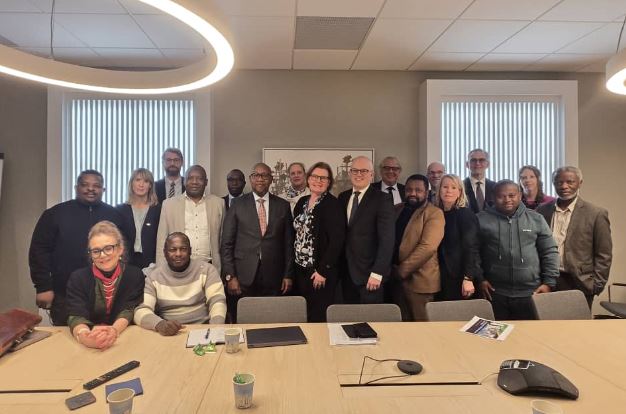
By Ambassador Mobhare Matinyi
Swedish Minister for International Development Cooperation, Benjamin Dousa, on December 5, announced the Swedish Government’s decision to cancel aid to five countries – Tanzania, Mozambique, Zimbabwe, Liberia and Bolivia – after reviewing policy priorities and security challenges.
However, while making the announcement, he accused the countries of being stuck in socialism and failing to progress. Tanzania’s Ambassador to Sweden, Mobhare Matinyi, responds by describing the achievements Tanzania has made in economic development over the past 60 years.
This is a translation of this article published on December 16, 2025, in the Swedish-language newspaper Aftonbladet.
The Swedish government on December 5, after reviewing its foreign policy priorities and security challenges, announced its decision to cancel its development cooperation assistance with five countries by the end of 2026, thus ending decades of assistance.
One of the countries affected is the United Republic of Tanzania, a country that has maintained good relations with Sweden for the past 62 years. The similarity in the ideology of social democracy between the two countries is what gave rise to this unique relationship.
Social democrats believe in social justice, freedom, equality, human dignity and solidarity within a democratic system that allows the state to intervene in capitalism to facilitate social welfare.
However, while Sweden has a multi-party democracy and cares about welfare in the midst of capitalism, Tanzania has chosen to follow a single-party democracy system that follows African Socialism which emphasizes self-reliance.
Sweden, therefore, took on the role of being a trainer of the cooperative movement in Tanzania at that time.
The two countries were very different in terms of economic development as Sweden, with a population of 7.5 million, had a GDP of US$17.33 billion in 1961, while operating a strong industrial economy while Tanzania, with a population of 10.3 million, had a GDP of US$2.83 billion and was more dependent on an agricultural economy.
Sweden, therefore, in 1963, saw the need to support Tanzania, then Tanganyika before it merged with Zanzibar in 1964 to form Tanzania, because the new country had shown a strong vision of development under President Julius Nyerere.
The recent announcement by the Swedish Government, unintentionally, gave rise to a narrative that distorted the image of Tanzania and all the achievements of this proud partnership. It was claimed that the countries mentioned had been “too socialist” for decades and as a result had “not progressed”.
Let me be perfectly clear: That statement does not apply to Tanzania in any way, not even in theory.
Let’s look at the facts: In the early 1960s Tanzania had only one affiliated university, but today it has 36 registered universities and 16 affiliated universities. Sweden, on the other hand, today has 18 registered universities and 12 affiliated universities.
Indeed, with a population of about 70 million, Tanzania still needs more universities compared to Sweden’s 10.7 million.
At that time, Tanzania had 1,343 health facilities, including 96 hospitals and 22 health centers. Today, Tanzania has 13,606 health facilities of all types, including 473 hospitals and 1,348 health centers.
We are grateful for the collaboration between Karolinska University Hospital in Stockholm and Muhimbili National Hospital, which is part of the Muhimbili University of Health and Allied Sciences.
Tanzania started with one international airport in Dar es Salaam but has added two more airports in Kilimanjaro and Zanzibar with two more under construction in Dodoma and Mwanza. Sweden has larger international airports in Stockholm, Gothenburg and a small one in Malmo.
Located in the strategic coastal belt of East Africa, Tanzania serves several landlocked countries through its four major ports of Dar es Salaam, Mtwara, Tanga and Zanzibar, and will soon begin construction of a large port in Bagamoyo.
There are also several ports on Africa’s three great lakes, Victoria, Tanganyika and Nyasa.
Tanzania’s extensive road and rail network is among the most efficient in Africa and continues to grow.
We commend the Government of Sweden for supporting our modern railway (SGR) project, the first electrified railway in East and Central Africa, in various ways.
The railway currently operates between Dar es Salaam and the capital Dodoma. Further railway projects in the north and south of the country, which will essentially connect more of the country to the Indian Ocean, are in the pipeline.
In a few years, Tanzania will become a major energy hub after the completion of a US$42 billion natural gas project with the Norwegian company Equinor. In addition, the East African Crude Oil Pipeline project from Uganda to the port of Tanga is nearing completion.
Similarly, Tanzania, which generates thousands of megawatts of electricity using hydroelectric power plants, is well prepared to use other renewable energy sources such as geothermal, wind and solar. Similarly, Tanzania has large coal reserves estimated at 1.9 billion tons.
Tanzania’s economic outlook is also impressive. Although its GDP is close to $90 billion, economic growth as measured by the World Bank and the Swedish Export Credit Agency (EKN) has been growing at an average of 5-7 percent annually since 2000.
Other strong economies such as Sweden, with a GDP of $630 billion, have experienced negative growth twice in the past five years.
In July 2020, Tanzania graduated from low-income countries to middle-income countries, which according to the World Bank marks two decades of significant economic progress and stability.
This is the fruit of reforms in the early 1990s that led the country to a mixed economy, with a multi-party democratic system, a process that took decades to mature.
Tanzania received 560 million Swedish kronor in 2024, approximately $60 million, in aid from Sweden.
But Tanzania is now shifting from aid to trade and investment; thus, it welcomes Swedish investors in key sectors such as manufacturing, services, mining, tourism, agriculture and technology.
Notably, in the year ending September 2025, Tanzania collected $4.43 billion from gold, the country’s leading export, while tourism is expected to bring in $6.0 billion by the end of 2025.
Tanzania is currently the world’s leading country for game tourism for the third consecutive year, boasting the Serengeti National Park, Ngorongoro Conservation Area, Mount Kilimanjaro and the beautiful beaches of Zanzibar.
Tanzania has significant reserves of valuable minerals, ranking third in Africa and sixth in the world. Finland is assisting us in the exploration and exploration of this unique wealth, which will certainly boost our economy. Sweden is encouraged to seize the opportunity to build mining plants in the country.
In 2024 alone, Tanzania attracted direct investment worth $9.31 billion from 901 registered projects, and the country is 140 percent food self-sufficient.
Despite these achievements, the current government under President Dr. Samia Suluhu Hassan continues to put in place more strategies to bring stable and sustainable development to Tanzanians.
Therefore, in all seriousness, with a multi-sectoral and market-oriented economy while showing impressive sustainable growth, labeling Tanzania as “soaked in backward socialism” is inaccurate and misleading.
The author is the Ambassador of the United Republic of Tanzania to the Nordic, Baltic and Ukraine countries, based in Stockholm.